

In this article
CHAPTER TWO : THE ATTACK
Eliana didn't sleep that night, even though she convinced her body to lie in bed for two full hours, eyes open on the ceiling, her mind replaying the calm voice she'd heard so many times it had started to lose meaning — the way a word loses its meaning if you repeat it enough times.
“Marcus Reed.”
By seven in the morning, she gave up on sleep and sat on the edge of the bed, her bare feet touching the cold floor. The apartment was unnaturally quiet, the gray light before full sunrise creeping in from behind curtains drawn tighter than usual.
She got up and went to the kitchen. She made coffee she didn't need so much as she needed to do something ordinary with her hands. Watching the water boil, she tried to lay out the previous night in her head with cold logic, as if she were analyzing a case for her university project instead of her own life.
An unknown man had called her. He'd said a name. He'd sent a photo. That was all that had actually happened. None of it proved anything.
She said this out loud, as if hearing the sentence spoken might give it more weight than the truth itself. Her hand, holding the mug, wasn't quite steady, and she set it down harder than she meant to, coffee jumping over the rim and onto her wrist. The small burn was almost a relief — something simple, something that made sense.
She sat down at her laptop with what was left of the coffee, opening the browser with a hand still faintly unsteady. She wasn't looking for anything specific — she just wanted to see the world going on as it should, an ordinary news page with ordinary headlines, something to convince her that last night had been nothing more than an isolated incident in a vast sea of ordinary events.
But the first headline that appeared made her heart stop for a full second.
Prominent Journalist Attacked Near His Home in City Center, Survives.
The photo loaded before the headline finished rendering, and she knew the face before she'd read a single word beneath it. She'd seen it only hours ago, on a different page, at two in the morning, in a different life.
She opened the article, her fingers trembling slightly on the keyboard. The story was still fresh, published less than an hour ago, its details as incomplete as breaking news always is — short sentences, conflicting information, updates being added at the bottom of the page as she read.
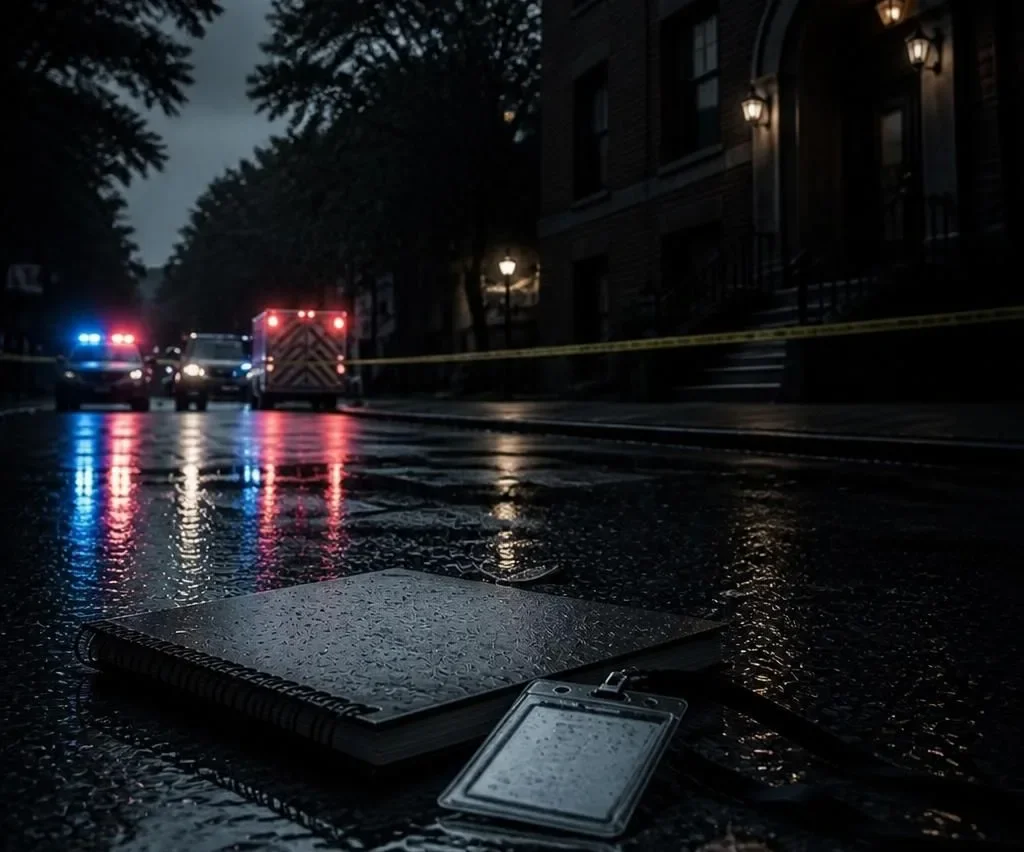
Investigative journalist Marcus Reed was attacked near the entrance of his residential building in the early hours of dawn. He was taken to the hospital, and medical sources have confirmed his condition is now stable. Police have not yet announced a suspect.
She read the paragraph twice. Then a third time.
He survived. He hadn't died. The voice on the phone had said someone will die tomorrow — not someone will be attacked. Maybe that meant the whole thing had been nothing more than an empty threat that hadn't played out exactly as described.
She tried to hold on to that thought, but some part of her knew the distinction was thin — the kind of thin a desperate person reaches for when they're looking for any crack of light in a solid wall.
She glanced at the clock at the top of the screen. 7:41 A.M. She did the math: the call had come in around two in the morning, and the attack, according to the article, had happened "in the early hours of dawn." No exact time had been published yet, but the gap between the threat and the act was small enough that it couldn't be coincidence.
She closed the laptop, her hand shakier than she'd expected, and sat in the silence of the apartment, listening to the faint hum of the refrigerator.
After several long minutes, she opened her phone again and scrolled back to the old conversation — the messages that had come in that night, still saved exactly as they were. She read them again, one by one.
Don't try to stop it.
He knows you exist.
Tomorrow, you'll understand why I called you.
Yesterday, these sentences had felt like vague threats — closer to the riddles of some disturbed person who enjoyed scaring strangers. Now, after reading the headline, every word felt far heavier than it had just a few hours ago.
She thought about calling the police directly this time, but her hand stopped halfway toward the emergency number. What exactly would she say? That an unknown number had called her last night and predicted an attack that had actually happened? They'd ask how she knew the call was connected to the incident. They'd ask why she hadn't called them the moment she received the threat instead of waiting until morning. And she'd have to admit that she hadn't — because she hadn't believed it enough at the time to act.
Instead, she opened the search engine again and typed Marcus Reed's name for the second time in less than twelve hours — this time searching not for who he was, but for any additional details that might explain why him, specifically.
She went back to his most recent article about Claire Morgan's disappearance, the one she'd opened last night without finishing. This time she read it more carefully, every sentence, every hint.
Reed had written that sources close to the investigation suspected Claire Morgan's disappearance wasn't an isolated case, but might be part of a broader pattern spanning years — one that included other cases that hadn't received the same media attention, for reasons that weren't clear. He hadn't named any of them explicitly, but he'd hinted at "old files closed with unexplained speed," without elaborating further.
Eliana lingered on that last line for a long time.
Old files closed with unexplained speed.
She scrolled down to the comments section — something she rarely bothered with, knowing how empty of real value it usually was. But something made her glance at it this time anyway.
Most of the comments were the usual things: condolences for the journalist, calls for better security, indignant questions about the police's performance. But one comment, posted three days before the attack, stopped her scrolling.
The username was a string of letters and numbers, nothing like a handle anyone would choose to be remembered by. The comment itself was four words long:
Some files stay open.
Nothing else. No punctuation beyond the period, no reply, no engagement — just the sentence, sitting alone beneath dozens of ordinary ones, posted at 3:14 in the morning three nights before a man had been attacked in the dark.
Eliana read it twice, then a third time, feeling the same unease she couldn't yet justify with anything solid. It could mean nothing. It could be a stranger being cryptic for the sake of it, the way people sometimes were online, performing mystery for an audience of no one. Or it could be exactly what it looked like: someone telling Reed, quietly and in public, that he hadn't been careful enough — that whatever he thought he'd buried by asking questions, someone else still had the key to.
She closed the page before she let herself sink further into interpretations that had no clear basis yet. Maybe she was searching for patterns everywhere now — exactly what she'd written in her university project about people who look for meaning in randomness, because randomness is harder to live with than any explanation, no matter how frightening.
Her phone buzzed suddenly, and she flinched, nearly knocking the mug off the desk.
It was a message from Maya.
“Did you see the news about the journalist? Awful. Thank God he made it.”
Eliana stared at the screen for a long moment before typing a reply, deleting it, then typing a simpler one.
“Yeah, saw it. Terrifying.”
She didn't mention the call. She wasn't ready yet to explain it to anyone, not even her closest friend, because she herself wasn't sure how the story should be told without sounding unhinged or delusional.
She spent the rest of the morning in a strange, quiet paralysis — she didn't go to her lecture, didn't open her university project's document, which now felt distant, as if it belonged to someone else's life. She just sat there, switching between the news window and her messaging app, refreshing both without meaning to.
It was the fourth refresh that changed something. A small update had been added to the bottom of the article — two lines, unremarkable to anyone else: Hospital officials have confirmed Reed is conscious and able to speak with investigators. No further details have been released.
Conscious. Able to speak. Eliana read the line three times, and something in her chest loosened just slightly, the way it does when a decision that had been circling finally lands.
She got up before she'd fully finished deciding, and by the time she reached her coat she'd already made up her mind: she opened the city map on her phone and searched for the name of the hospital.
She didn't know exactly what she'd say or do once she got there. She had no clear plan — only the thought that a man who was awake could answer a question no headline could, and that she couldn't spend another hour in this apartment waiting for her phone to buzz again.
She put on her coat, grabbed her keys, and paused for a moment at the door.
Her eyes drifted, without meaning to, to the clock on the wall. 12:17 P.M.
She noticed only the seventeen. She didn't understand why a faint shiver ran down her arms before she opened the door and stepped out into the hallway.
Keep up with Elara Voss
Choose site notifications, email, or both. Guests can subscribe by email without an account.
Report this article
Tell our review team about a problem with this content. Your details will not be shown to the author or other readers.
Your report could not be sent. Please try again later.
Sign in to report an article



Discussion
comments (0)
Share a perspective. Start a thoughtful conversation.
please login to be able to comment