
في هذا المقال
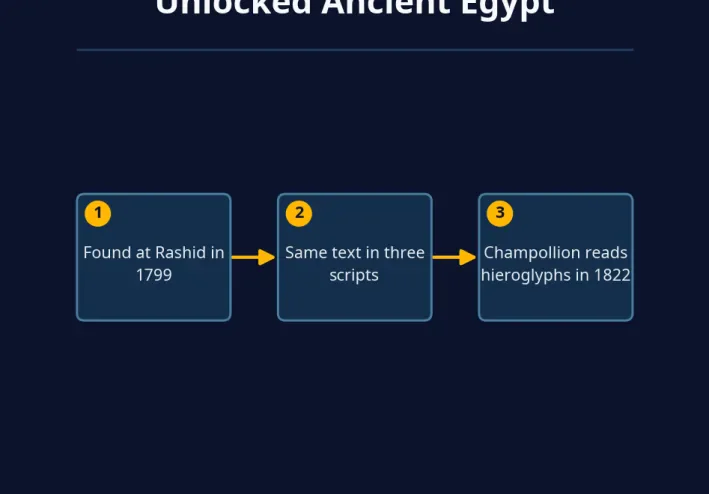
For nearly fifteen centuries, nobody on Earth could read Egyptian hieroglyphs. The temples, tombs, and papyri of ancient Egypt were covered in symbols that had gone silent. Then, in 1799, soldiers repairing a fort found a dark stone with writing on it. That stone changed everything.

A discovery in the Nile Delta
In July 1799, during the French campaign in Egypt, soldiers were strengthening an old fort near the town of Rashid, which Europeans called Rosetta. They noticed a large slab of dark granodiorite covered with carved text. It was part of a larger stone that had been broken, and the piece was about 112 centimetres tall. Officers recognised that it could be important, and scholars with the expedition began to study it.
One message, three scripts
The stone carries a decree issued in 196 BC by priests in the name of King Ptolemy V. The same text is written three times: in Egyptian hieroglyphs, in Demotic, a later everyday Egyptian script, and in ancient Greek. Scholars of the time could still read Greek. That meant the stone offered a rare chance to compare a known language with two unknown scripts.
From French hands to the British Museum
After the French army lost in Egypt, the stone passed to British forces under the terms of the 1801 surrender. It reached England in 1802 and has been displayed at the British Museum in London since then. Egypt has asked for its return in recent years, so the stone remains part of a living debate about where cultural treasures belong.
The race to decode it
Several scholars worked on the text. The English scientist Thomas Young made important early progress, showing that the oval rings, called cartouches, held royal names such as Ptolemy. The key breakthrough came from Jean-François Champollion, a French scholar who knew Coptic, the late form of the Egyptian language. In 1822 he announced that hieroglyphs were not only symbols for ideas. They also recorded sounds, and they mixed both systems in one script.
Why it still matters
Once the code was cracked, historians could read thousands of Egyptian inscriptions for the first time. Letters, laws, hymns, and royal records began to speak again after centuries of silence. Today the phrase "Rosetta Stone" is also used for any key that unlocks a hard problem, and the stone remains one of the most visited objects in the British Museum.
The lesson
The Rosetta Stone shows how progress often comes from combining small pieces: a lucky discovery, a text in a known language, and patient scholars who kept testing ideas for more than twenty years. A broken slab of rock became a bridge to three thousand years of human history.
تابع جديد Eng Abdo Mahrous Nour
اختر إشعارات الموقع أو البريد أو الاثنين. الزائر يقدر يشترك ببريده دون تسجيل حساب.
ادعم الكاتب
أعجبك المقال؟ أرسل هدية إلى Eng Abdo Mahrous Nour
هديتك تصل إلى الكاتب مباشرة وتتحول إلى أرباح في محفظته.
كن أول من يدعم هذا المقال بهدية 💝
كيف تعمل أرباح الهدايا؟الإبلاغ عن المقال
لو لاحظت مشكلة في المحتوى، أرسلها لفريق المراجعة. لن تظهر بياناتك لكاتب المقال أو للقراء.
تعذّر إرسال البلاغ الآن. حاول مرة أخرى لاحقًا.
سجّل الدخول لإرسال بلاغ


النقاش
التعليقات (0)
فكرة تضيفها، أو سؤال يفتح حوارًا.
الرجاء تسجيل الدخول لتتمكن من التعليق