

في هذا المقال
Queen Meryetamun: The Royal Princess of Ancient Egypt and Her Place in the 19th Dynasty
Queen Meryetamun, also written as Meritamun, Meritamen, or Merit-Amun, was one of the prominent royal women of Egypt’s Nineteenth Dynasty. She is best known as a daughter of Pharaoh Ramesses II, one of the most powerful and celebrated rulers of ancient Egypt, and Queen Nefertari, his principal royal wife. Her name, commonly translated as “Beloved of Amun” or “Beloved by Amun,” reflects the importance of the god Amun in Egyptian religious and royal culture.
Meryetamun lived during the thirteenth century BCE, an era marked by monumental architecture, royal propaganda, military campaigns, diplomatic relations, and the consolidation of Egyptian power under Ramesses II. Her position within the royal family gave her access to the religious and political world of the Egyptian court, while her surviving statues and monuments provide valuable evidence of how royal daughters could acquire public visibility and prestige.
Yet Meryetamun remains a figure whose life must be reconstructed carefully. Although her royal parentage and monumental representations are well established, important details about her marriage, precise political responsibilities, and later years remain uncertain. Distinguishing what the monuments actually demonstrate from what historians infer is essential to understanding her historical significance.
1. Historical background: Egypt under Ramesses II


6
Meryetamun lived during the reign of Ramesses II, who ruled Egypt for approximately 66 years, conventionally dated to around 1279–1213 BCE. His reign was characterized by extensive building projects, military expeditions, royal monuments, and efforts to present the pharaoh as the defender and restorer of Egyptian greatness.
Ramesses II belonged to the Nineteenth Dynasty, which followed the religious and political upheavals associated with the Amarna period. During the reigns of Akhenaten and his successors, the traditional cults had experienced profound disruption, particularly through the elevation of the Aten and the diminished position of Amun's priesthood. The restoration of traditional religious institutions under Tutankhamun, Ay, and Horemheb, followed by the establishment of the Nineteenth Dynasty, formed part of the broader background to Ramesses II's rule.
By Meryetamun's lifetime, the cult of Amun had regained its prominent place in Egyptian religious life. The great temples of Thebes, particularly Karnak and Luxor, were important centers of worship, wealth, administration, and royal ceremony.
Royal women occupied an important position within this world. The king's principal wife could participate in religious ceremonies, bear royal heirs, and represent the royal household in monumental art. Royal daughters could likewise be represented in temple reliefs and statues, linking the royal family with the gods and reinforcing the legitimacy of the ruling dynasty.
Meryetamun's life belongs to this wider history of kingship, religion, and royal representation.
2. Family and royal identity
Meryetamun was a daughter of Ramesses II and Nefertari, the celebrated Great Royal Wife whose tomb in the Valley of the Queens is among the finest surviving examples of New Kingdom funerary art.
The Egyptian Ministry of Tourism and Antiquities identifies Meryetamun as the king's fourth daughter. Her position in the royal family is also supported by the representations of royal children at Abu Simbel and by inscriptions associated with her statues.
Ministry of Tourism and Antiquities
+1
Her known family included several brothers and sisters, among them:
Amun-her-khepeshef, one of Ramesses II's important sons and an early heir to the throne.
Pareherwenemef, a royal prince associated with military representations.
Meryatum, who later became a high priest of Ra at Heliopolis.
Henuttawy, one of the daughters associated with Nefertari's family.
These relationships help situate Meryetamun within a large royal household whose members occupied religious, military, and dynastic roles. However, surviving evidence does not provide a complete record of all her siblings or establish every detail of their personal relationships.
Wikipedia
+1
Her mother, Queen Nefertari


Nefertari was much more than the mother of a royal princess. She held the title of Great Royal Wife and was represented prominently in royal monuments. Her temple at Abu Simbel, dedicated in association with the goddess Hathor, demonstrates the exceptional visibility she enjoyed in the religious landscape of Ramesses II's reign.
A multidisciplinary study published in PLOS ONE examined the fragmentary human remains attributed to Nefertari, considering archaeological, anthropological, chemical, and radiocarbon evidence. The study found the identification plausible, although the remains are incomplete and the attribution cannot be treated as absolutely certain.
PLOS One
+1
Nefertari's death appears to have occurred before the thirtieth regnal year of Ramesses II, although the precise date remains debated. Following her death, Meryetamun rose in status and eventually became one of her father's Great Royal Wives.
This transition is significant because it illustrates how royal women's positions could change as the composition of the royal household evolved. Meryetamun's elevation did not necessarily mean that she inherited all her mother's religious or political responsibilities; the evidence must be considered title by title and monument by monument.
3. From royal daughter to Great Royal Wife
One of the most striking aspects of Meryetamun's life is that she became a Great Royal Wife of her own father, Ramesses II, following the death of Nefertari. She was not the only royal daughter of Ramesses II to receive this status. Bint-Anath and Nebettawy are also associated with marriages between the king and his daughters.
PMC
+1
To modern readers, such marriages can appear shocking. Within ancient Egyptian royal ideology, however, royal marriage operated according to dynastic and religious concepts that did not always correspond to modern social conventions.
Several distinctions are essential when interpreting this practice.
First, a royal marriage could strengthen the symbolic unity of the ruling dynasty. The pharaoh was represented not merely as a political ruler but as a figure whose kingship was connected to divine order.
Second, the title Great Royal Wife conveyed an elevated position within the court, but it did not automatically make its holder the mother of the next king. Ramesses II had numerous children, and succession depended on several factors, including the survival, status, and political circumstances of potential heirs.
Third, the existence of a royal marriage does not, by itself, establish the couple's private relationship, the practical functions of the marriage, or whether it produced children. The available evidence does not justify inventing intimate details about Meryetamun's life.
Her marriage is therefore best understood as part of the dynastic and religious structure of Ramesses II's monarchy rather than as an isolated personal event.
4. Her titles and religious responsibilities


Meryetamun's surviving statues provide particularly valuable evidence of her public identity. They depict her in elaborate royal dress and preserve titles associated with both her royal descent and her religious activities.
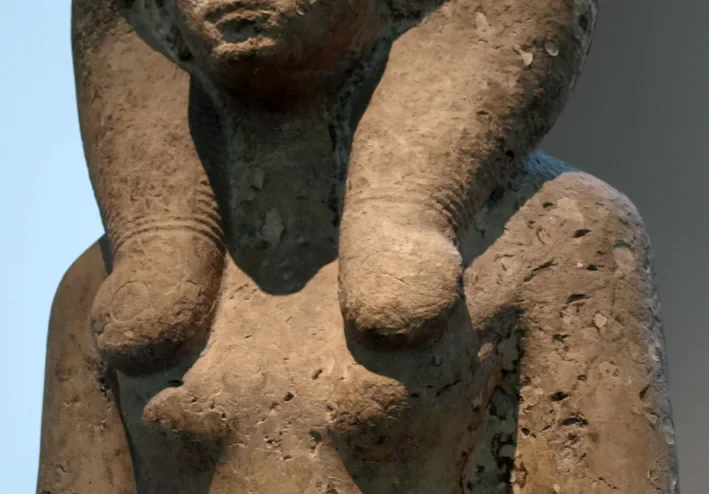
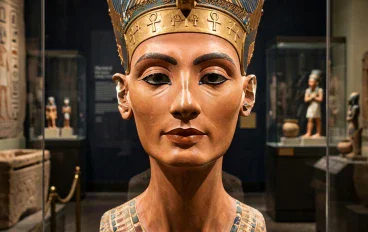
One important example is the statue commonly called the White Queen, now displayed at the Hurghada Museum. The statue is made of painted limestone and retains traces of its original coloration. Its identification as Meryetamun rests on its preserved titles and its close relationship to other representations of the princess.
Ministry of Tourism and Antiquities
+1
The menat necklace and the goddess Hathor
In the statue, Meryetamun holds a menat necklace, a ritual object associated with music, sound, fertility, protection, and religious ceremonies. Its counterweight is shaped as a representation of Hathor.
Her titles include references to handling the menat of Hathor and the sistrum of Mut. The sistrum was a ritual musical instrument used in religious performances, particularly in cults involving goddesses.
These objects were not simply decorative accessories. They helped communicate the queen's association with religious institutions and the performance of sacred duties.
The menat and sistrum also illustrate how royal women could participate in Egyptian religion through ritual roles. Their religious identity could be expressed in sculpture, inscriptions, ceremonial objects, and temple imagery.
The relationship with Amun, Mut, and Hathor
Meryetamun's name invokes Amun, one of the most important gods of New Kingdom Egypt. Her titles also connect her with Mut and Hathor, both of whom had significant religious roles.
Amun: The god whose name appears in Meryetamun's name and whose cult became especially influential during the New Kingdom.
Mut: A goddess closely associated with Amun and the Theban religious tradition.
Hathor: A goddess associated with music, motherhood, protection, joy, and royal ideology.
These associations placed Meryetamun within a religious world in which royal identity and divine service were closely intertwined. Nevertheless, her titles should not be used to claim that she controlled these cults or held political authority over their institutions without additional evidence.
5. The colossal statue at Akhmim


6
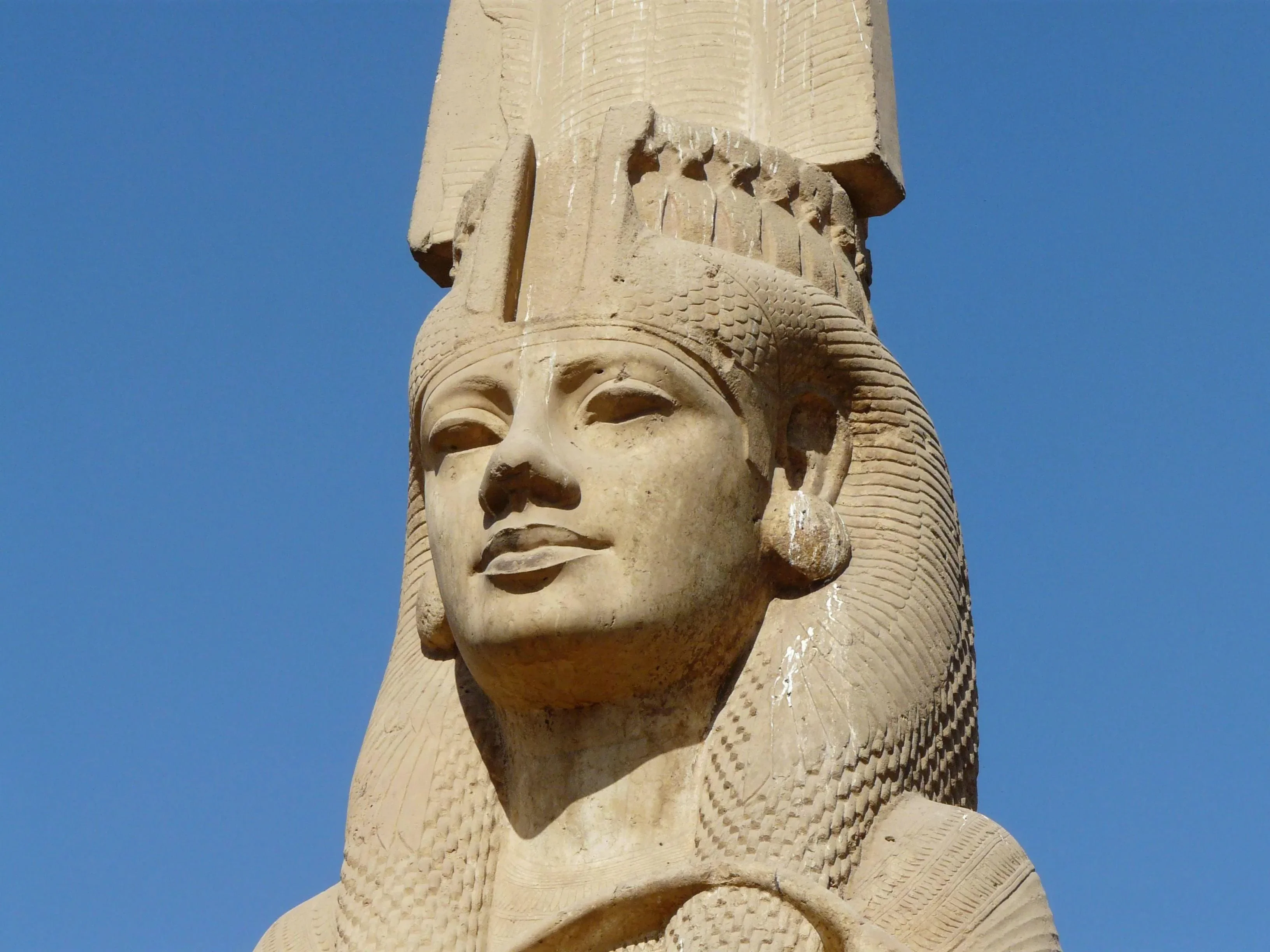
Among the monuments associated with Meryetamun, the colossal statue at Akhmim is especially important. Akhmim, in Upper Egypt, was an important religious center associated with the god Min, whose cult had deep roots in Egyptian history.
According to Egypt's Ministry of Tourism and Antiquities, the statue of Meryetamun at Akhmim was discovered in 1981. It is made of limestone, stands approximately 13 metres high, and weighs around 31 tonnes. The statue was installed and displayed at the archaeological site in 1991. A colossal statue of Ramesses II was subsequently restored and raised beside it in 2019.
معبد ميريت آمون
+1
The scale of the monument is significant. A statue measuring approximately 13 metres was not an ordinary private portrait. It was a monumental statement of royal presence, designed to make the king's daughter visible within an important religious landscape.
Why was Meryetamun represented on such a scale?
Several interpretations are possible.
Royal prestige: The statue presented Meryetamun as a member of the reigning dynasty. Her connection with Ramesses II gave her a special status within the royal hierarchy.
Religious presence: Its setting at a temple associated with Min placed the queen within a sacred environment where monumental images reinforced relationships between rulers, gods, and worshippers.
Dynastic representation: The neighbouring statue of Ramesses II created a visual relationship between father and daughter, although the precise original arrangement and the circumstances of the monuments' display should be assessed through their archaeological and inscriptional evidence.
It would be an overstatement to conclude that the statue proves Meryetamun personally governed Akhmim or exercised independent political power there. Monumental scale demonstrates importance and visibility, but not necessarily administrative authority.
An important complication: reused royal monuments
The Ministry of Tourism and Antiquities reports that another colossal statue associated with Meryetamun was later reinscribed during the reign of Osorkon II of the Twenty-second Dynasty, in connection with his wife Karomama. Both names are visible on the monument.
Ministry of Tourism and Antiquities
+1
This later reuse is an important reminder that Egyptian monuments frequently acquired new meanings after the original rulers had died. Later kings could adapt earlier statues to support their own royal and religious identities.
The existence of later inscriptions does not erase the monument's earlier history. Instead, it reveals how ancient Egyptian rulers repeatedly appropriated the material legacy of their predecessors.
6. The White Queen: Understanding the statue's artistic details
The statue known as the White Queen offers a more intimate view of Meryetamun's royal image. Unlike the colossal statue at Akhmim, it allows us to examine the details of royal dress, jewellery, hairstyle, and religious symbolism.
The Egyptian Ministry of Tourism and Antiquities identifies several notable features.
Ministry of Tourism and Antiquities
+1
The crown and royal cobras
Meryetamun wears a crown incorporating rows of rearing cobras, or uraei, associated with royal protection and sovereignty. The surviving arrangement includes cobras bearing solar disks.
The uraeus was a powerful symbol of Egyptian kingship. Its presence on a royal woman's headdress conveyed protection and royal prestige, although the precise significance of individual crown elements must be established from their archaeological and iconographic context.
The elaborate wig
Her tripartite wig is divided into three principal sections, with carefully carved locks. Traces of blue pigment survive in parts of the sculpture.
This surviving colour is particularly valuable. It reminds us that ancient Egyptian statues were not necessarily intended to look like bare, monochromatic stone. Paint and surface decoration helped create the intended visual effect.
Jewellery and the broad collar
Meryetamun wears a broad collar composed of multiple rows of beads, earrings, and bracelets. Such jewellery communicated status and reflected the sophisticated artistic traditions of the Ramesside court.
The sculpture also preserves details that suggest the use of colour to evoke materials such as gold and richly coloured stones.
The ritual necklace
The menat necklace she holds is especially important because it links her portrait to religious practice. Its association with Hathor reinforces the impression that the statue was intended to express more than physical beauty.
Taken together, these details present Meryetamun as a royal woman whose identity combined dynastic rank, ritual participation, and the visual conventions of New Kingdom art.
7. The tomb of Meryetamun: QV68

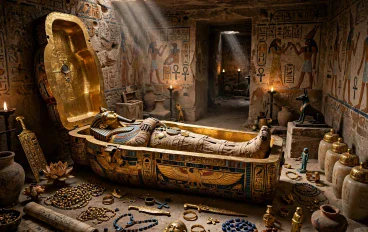
Meryetamun's funerary monument is another major source for her history. Her tomb, designated QV68, lies in the Valley of the Queens, the royal necropolis on the west bank of the Nile near ancient Thebes.
The tomb was recorded by early Egyptologists, including Jean-François Champollion and Karl Richard Lepsius, and was later excavated by Ernesto Schiaparelli, director of the Egyptian Museum in Turin. The tomb's inscriptions identify its owner as Meryetamun, the king's daughter and Great Royal Wife.
Wikipedia
+1
Architecture and decoration
The tomb contains a principal hall, a side chamber, and a burial chamber. Its religious decoration places Meryetamun before several Egyptian deities, including:
Neith, a goddess associated with creation, protection, and warfare.
Thoth, the god associated with writing, knowledge, and reckoning.
Ra-Harakhti, a solar deity combining aspects of Ra and Horus.
Hathor, a goddess associated with protection, music, and regeneration.
Osiris, the god of the dead and ruler of the underworld.
These scenes were not simply illustrations of religious beliefs. They formed part of a funerary programme intended to help the deceased participate in the divine world and attain renewed existence after death.
Meryetamun is also shown performing offerings. Such scenes reflect established conventions in Egyptian funerary art, in which ritual actions expressed the deceased's relationship with the gods.
The royal sarcophagus
Meryetamun was buried in a red granite sarcophagus, fragments of which are preserved in the Berlin Museum. Its inscriptions identify her through her royal titles and name.
Wikipedia
+1
The surviving remains of the burial demonstrate that she received funerary treatment appropriate to a woman of high royal status.
However, the tomb's survival in a damaged state means that it cannot provide a complete picture of her original burial. Ancient tomb robbery, the destruction of funerary equipment, and the loss of objects complicate any attempt to reconstruct the original arrangement.
What can the tomb tell us about her death?
The tomb confirms that Meryetamun was accorded a royal burial and that her funerary identity was carefully linked to Egyptian religious traditions.
It does not, by itself, reveal her exact age at death, the cause of her death, or the details of her final years. Such questions require independent evidence, and claims about them should remain qualified unless supported by identifiable archaeological or textual findings.
8. Meryetamun and the position of royal women in the Nineteenth Dynasty
Meryetamun's career provides an opportunity to examine the position of royal women during the reign of Ramesses II.
The Nineteenth Dynasty witnessed extensive royal construction and a strong emphasis on the public representation of kingship. Women of the royal household appeared in statues, reliefs, religious ceremonies, and funerary monuments. Their images helped express the legitimacy and continuity of the dynasty.
Meryetamun's surviving evidence reveals several dimensions of this position.
First, royal descent mattered. Her identity as the daughter of Ramesses II was repeatedly expressed in her titles and monuments. Her parentage was a central element of her public status.
Second, royal marriage could change a woman's position. Her elevation to Great Royal Wife after Nefertari's death demonstrates how rank within the royal household could change over time.
Third, religious activity was a visible aspect of royal women's identity. Her association with the menat of Hathor and the sistrum of Mut connected her public image to the cultic traditions of Egypt.
Fourth, monuments preserved dynastic memory. The statues at Akhmim and the White Queen sculpture helped ensure that her name and image could be encountered beyond the immediate circle of the royal court.
Nevertheless, visibility should not be confused with autonomy. The monuments tell us how Meryetamun was represented and what titles she held, but they offer far less information about her independent decisions, private life, or influence over royal policy.
9. Meryetamun in the context of Ramesses II's other royal women
Ramesses II had several important wives, including Nefertari and Isetnofret, as well as a very large number of children. Meryetamun's position must therefore be understood within a complex royal household rather than through the assumption that one woman held every form of influence.
Nefertari was celebrated through her temple at Abu Simbel, her richly decorated tomb, and evidence of her participation in royal and diplomatic affairs. Isetnofret was another important royal wife whose children played major roles in the dynasty's succession. Meryetamun, meanwhile, is particularly notable for the combination of royal descent, Great Royal Wife status, religious titles, and monumental representations
Her career also raises a broader historical question: how did royal daughters maintain or expand their status after the death of their mothers?
Meryetamun's promotion to Great Royal Wife provides one answer. Yet it would be misleading to assume that all royal daughters followed the same path or that royal marriage necessarily translated into political power.
The available sources establish her elevated status. They do not reveal enough to reconstruct a detailed political rivalry between Meryetamun and other women at court.
10. What happened to Meryetamun after her father's reign?
Meryetamun belongs to the world of Ramesses II, but the history of her monuments continued long after his death.
Her burial in QV68 preserved evidence of her royal identity, while the later reuse of an earlier statue during the Twenty-second Dynasty demonstrates that royal sculpture could remain meaningful centuries after its creation.
These later histories should be distinguished from Meryetamun's own lifetime. A statue reinscribed for a later queen does not mean that the original Meryetamun remained politically active, nor does it establish that she was remembered continuously in every period.
Her exact date of death and the full circumstances of her later life remain uncertain. Her tomb and inscriptions provide a stronger foundation for historical reconstruction than speculation about her personal relationships or the motivations of later rulers.
11. Historical significance: What makes Meryetamun important?
Meryetamun is not as widely known today as Nefertari or Cleopatra VII, but her monuments make her an important subject for the study of ancient Egyptian history.
Her significance rests on several interconnected themes.
Royal women and political legitimacy
Her titles and statues demonstrate how royal daughters could become highly visible representatives of the ruling dynasty. The relationship between her royal parentage and her later status as Great Royal Wife reveals the importance of family relationships in Egyptian kingship.
Religion and royal identity
Her ritual objects and titles show how religious service contributed to the representation of royal women. The associations with Mut and Hathor connect her portrait to wider traditions of royal protection and divine renewal.
Monumental art and royal memory
The colossal statue at Akhmim and the White Queen statue preserve different aspects of her public identity. One emphasizes monumental scale and royal presence; the other preserves intricate details of dress, jewellery, and ritual symbolism.
Funerary belief and the afterlife
Her tomb, QV68, offers evidence of the religious traditions through which Egyptian elites understood death and regeneration. Its scenes and inscriptions situate her within the wider funerary culture of the Ramesside period.
The reuse of ancient monuments
The later reinscription of a statue for Karomama demonstrates that Egyptian monuments could acquire new identities and functions under later rulers. Such reuse is a valuable subject in its own right, revealing how the past was adapted to serve the needs of subsequent dynasties.
12. Historical evidence versus speculation
A responsible biography of Meryetamun must distinguish documented facts from interpretations.
| Historical question | What the evidence supports |
|---|---|
| Who were her parents? | Ramesses II and Queen Nefertari. |
| What was her royal status? | She was a royal daughter and later a Great Royal Wife. |
| What religious roles are recorded? | Titles associate her with the menat of Hathor and the sistrum of Mut. |
| Where was she buried? | Her tomb is identified as QV68 in the Valley of the Queens. |
| Where is she represented monumentally? | Among other places, at Akhmim and in the White Queen statue now at Hurghada Museum. |
| Did she independently rule Egypt? | The evidence discussed here does not establish that she ruled as pharaoh. |
| Do we know the precise cause of her death? | Not from the evidence discussed here. |
| Can we reconstruct her private thoughts and relationships? | No reliable basis exists for detailed claims of this kind. |
This distinction is important because popular accounts of ancient Egypt sometimes turn suggestive evidence into elaborate stories. Meryetamun's actual monuments are sufficiently interesting without adding unsupported details.
Conclusion
Queen Meryetamun was a royal daughter of Ramesses II and Nefertari who later became a Great Royal Wife of her father. Her historical importance is documented through her titles, religious associations, funerary monument, and surviving statues.
The colossal monument at Akhmim illustrates the scale on which she could be represented, while the White Queen statue preserves the intricate artistic and religious language of the Ramesside court. Her tomb, QV68, provides further evidence of her status and the funerary traditions available to elite royal women.
Meryetamun's biography also demonstrates the limitations of historical reconstruction. We can establish her parentage, rank, and major monuments with considerable confidence, but many details of her personal life remain unknown. The most convincing account of her life is therefore one grounded in inscriptions, archaeology, and careful interpretation.
Ultimately, Meryetamun offers an important perspective on the relationship between royal family, religion, art, and memory in the age of Ramesses II. Her surviving monuments preserve not merely the image of a king's daughter, but evidence of how an elite Egyptian woman could be represented within the political and sacred world of the New Kingdom.
Selected references for further research
Egyptian Ministry of Tourism and Antiquities, Statue of Queen Meritamun.
Ministry of Tourism and Antiquities
Egyptian Ministry of Tourism and Antiquities, Statue of Meritamun — the White Queen.
Ministry of Tourism and Antiquities
Egyptian Ministry of Tourism and Antiquities, Temple of Merit-Amun at Akhmim.
معبد ميريت آمون
Habicht, M. E., et al. “Queen Nefertari, the Royal Spouse of Pharaoh Ramses II: A Multidisciplinary Investigation of the Mummified Remains Found in Her Tomb (QV66).” PLOS ONE (2016). Read the study.
PLOS One
Getty Conservation Institute, Valley of the Queens Assessment Report, volumes 1 and 2. Volume 1 and Volume 2.
Getty
+1
تابع جديد محمد عبد السلام الشامي
اختر إشعارات الموقع أو البريد أو الاثنين. الزائر يقدر يشترك ببريده دون تسجيل حساب.
الإبلاغ عن المقال
لو لاحظت مشكلة في المحتوى، أرسلها لفريق المراجعة. لن تظهر بياناتك لكاتب المقال أو للقراء.
تعذّر إرسال البلاغ الآن. حاول مرة أخرى لاحقًا.
سجّل الدخول لإرسال بلاغ



النقاش
التعليقات (0)
فكرة تضيفها، أو سؤال يفتح حوارًا.
الرجاء تسجيل الدخول لتتمكن من التعليق