


في هذا المقال
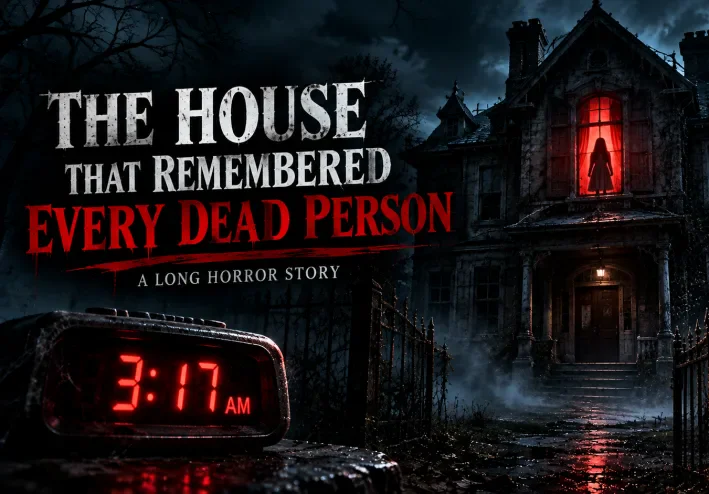
The House That Remembered Every Dead Person
A Long Horror Story
Chapter One: The House at the End of Blackwood Road
When Ethan Miller inherited his grandfather's house, he almost refused to take it.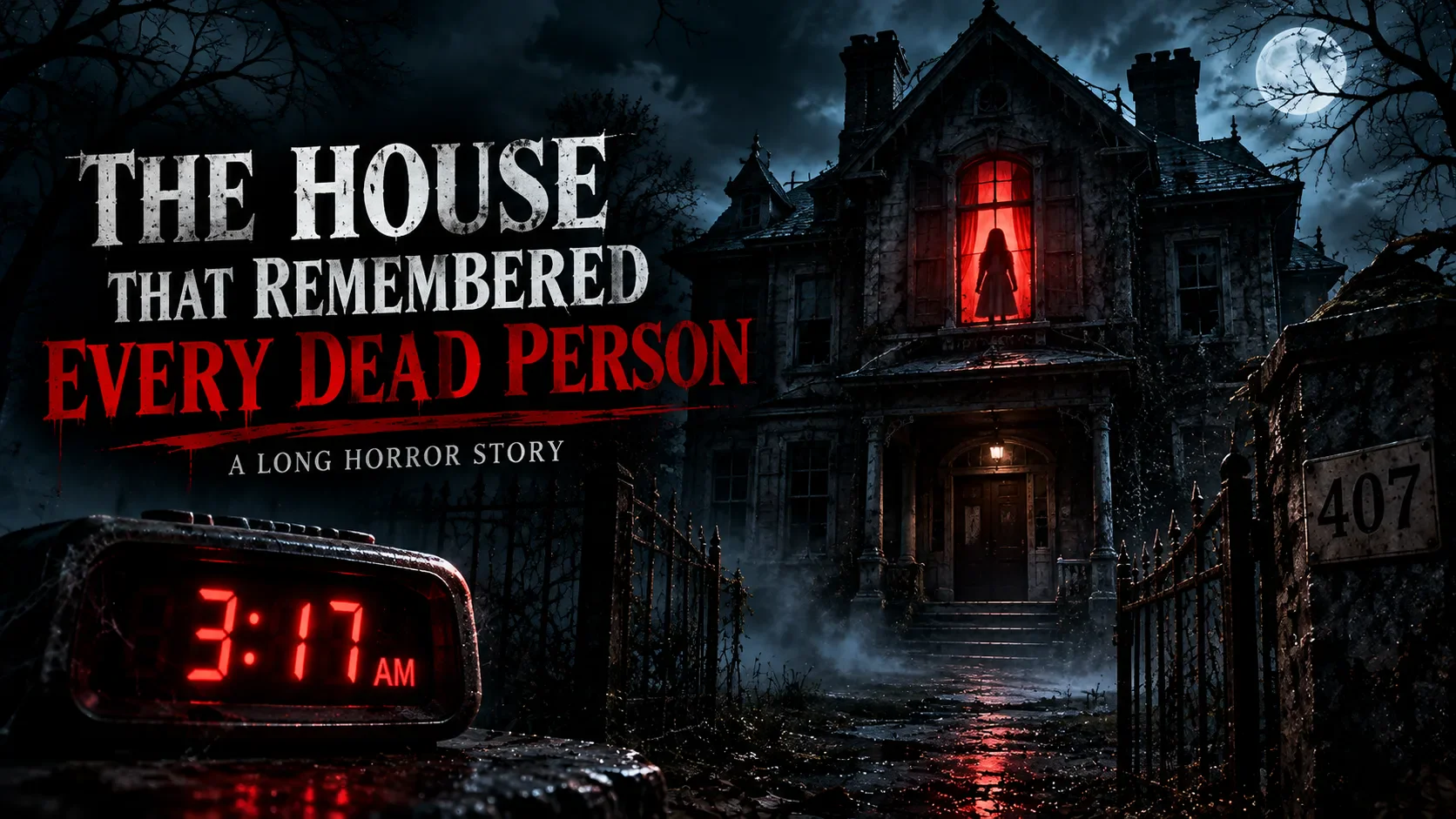
He had not seen his grandfather, Arthur, in nearly twelve years. Their last conversation had ended in an argument, and Ethan had never forgiven the old man for what he said that night.
“You will understand when the house calls your name,” Arthur had whispered over the phone.
At the time, Ethan thought it was the rambling of a lonely old man.
Three weeks later, Arthur was found dead in his bedroom.
The official report listed heart failure as the cause of death. There were no signs of a struggle, no broken windows, and no evidence that anyone had entered the property.
But there was one detail that the police never explained.
Every clock in the house had stopped at exactly 3:17 AM.
Now, standing outside the property on a cold November evening, Ethan finally understood why nobody in the village wanted to talk about it.
The house stood at the end of Blackwood Road, surrounded by dead trees and a rusted iron fence. Its windows were tall and narrow, like dark eyes watching the road. The roof sagged in the middle, and ivy covered the stone walls.
There was no light inside.
Yet Ethan was certain he had seen someone standing behind an upstairs window when he first arrived.
He looked again.
Nothing.
“It's just an old house,” he muttered.
He unlocked the front door.
The smell hit him immediately.
Dust, damp wood, and something strangely sweet, like flowers left too long beside a grave.
The entrance hall was filled with covered furniture. A grand staircase rose toward the second floor, and an enormous mirror hung on the wall opposite the front door.
Ethan walked past it.
Then he stopped.
His reflection had not moved.
For one impossible second, the figure in the mirror remained standing still, staring straight ahead while Ethan turned his head.
Ethan spun around.
The reflection moved with him.
He stared at the glass, his heart pounding.
“I'm tired,” he whispered.
He had driven for six hours. He had barely slept the night before. There had to be an explanation.
He carried his suitcase upstairs and chose the bedroom at the end of the hallway.
On the bedside table, he found an envelope with his name written in his grandfather's handwriting.
Inside was a single sheet of paper.
Ethan,
If you are reading this, then I am dead, and the house has chosen you.
There are three rules you must follow.
First: Never answer a voice calling your name after midnight.
Second: If you hear footsteps in the attic, stay in your room. There is no attic in this house.
Third: At 3:17 AM, no matter what you hear, do not look into the hallway mirror.
If you break any of these rules, the house will remember you.
And once it remembers you, it will never let you leave.
Ethan read the letter twice.
Then he laughed nervously.
His grandfather had always enjoyed frightening people with strange stories. Perhaps this was one last attempt to get a reaction from him.
He folded the letter and placed it in a drawer.
Outside, the wind picked up.
Somewhere deep inside the house, a door slammed shut.
Ethan looked toward the bedroom entrance.
He was certain he had closed every door downstairs.
Chapter Two: The First Night
At 11:45 PM, Ethan was still awake.
The bedroom had no television, and the mobile signal was almost nonexistent. He had spent an hour trying to contact his friend Daniel before giving up.
He decided to explore the house instead.
The upstairs hallway was lined with old photographs. Most showed members of his family, though he recognized very few of them.
His grandfather appeared in several pictures, always standing in the background.
But something about the photographs disturbed Ethan.
In the oldest one, Arthur stood beside a woman in a black dress. She had a pale face and dark circles beneath her eyes.
Someone had scratched out her face.
In the next photograph, Arthur stood with three children.
Their faces had also been scratched away.
Ethan moved closer.
On the back of the frame, someone had written a date.
October 17, 1968.
He remembered his grandfather once mentioning a sister who had died as a child. But he had never heard anything about these other people.
He lifted another frame.
This photograph showed a young man standing outside the house. The man wore an old-fashioned suit and had one hand resting on the shoulder of a little girl.
The girl's face was perfectly clear.
She was smiling.
Ethan recognized her immediately.
It was the same girl he had seen standing in the upstairs window.
His breath caught in his throat.
The girl looked about eight years old. Her hair was tied with a white ribbon, and she wore a dress that looked almost identical to the one in the photograph beside it.
Ethan turned the frame over.
There was no date.
Only four words written in faded ink:
She is still waiting.
A floorboard creaked behind him.
Ethan turned.
At the far end of the hallway, a bedroom door stood slightly open.
He was certain it had been closed earlier.
A faint yellow light shone through the gap.
“Hello?” he called.
No answer.
He approached the door and pushed it open.
The room was empty except for an old wooden bed, a wardrobe, and a small rocking chair.
The chair moved gently back and forth.
Ethan stared at it.
There was no open window. No breeze. Nothing that could have moved it.
Then he heard a little girl's voice.
“Are you my brother?”
The voice came from inside the wardrobe.
Ethan backed away so quickly that his shoulder struck the wall.
“Who's there?”
A soft giggle came from behind the wardrobe door.
Then the voice whispered:
“Grandpa said you would come.”
Ethan ran back to his bedroom and locked the door.
He sat on the bed, trying to slow his breathing.
For the next hour, he heard nothing.
Then, at exactly midnight, someone knocked on his bedroom door.
Three times.
Ethan said nothing.
A woman's voice came from the other side.
“Ethan, darling. Open the door.”
He froze.
He knew that voice.
It belonged to his mother.
His mother had been dead for nine years.
“Ethan, please,” the voice whispered. “It's cold out here.”
His eyes filled with tears.
He wanted to believe it was a dream. He wanted to open the door and find his mother standing there, alive and smiling.
But he remembered the first rule.
Never answer a voice calling your name after midnight.
The doorknob began to turn.
“Ethan,” his mother's voice said again.
Then it changed.
The warmth disappeared from it, replaced by something hollow and angry.
“Why won't you let me in?”
The knocking stopped.
For several minutes, Ethan sat motionless.
Then came the sound of footsteps moving away down the hallway.
Slowly, he reached for his phone.
The screen showed 3:16 AM.
He looked toward the bedroom door.
A second later, the clock changed.
3:17 AM.
From somewhere outside, a mirror shattered.
Then every light in the house turned on at once.
Chapter Three: The Room That Wasn't There
Ethan did not sleep again that night.
At sunrise, he left the house and drove to the nearest village.
He found a small café beside the main road and ordered coffee. The woman behind the counter looked at him carefully.
“You're Arthur Miller's grandson, aren't you?”
Ethan nodded.
The woman stopped wiping the counter.
“You shouldn't be staying there.”
“Why does everyone keep saying that?”
She glanced toward the window, as if someone might be listening.
“Because people who spend the night in that house don't always come back the same.”
Ethan almost laughed.
“Look, my grandfather died there. I'm trying to understand what happened. Did he have any enemies? Was there something wrong with him?”
The woman remained silent for a long moment.
Then she pulled a chair toward him.
“My name is Margaret. My grandmother worked for your family when she was young.”
She lowered her voice.
“She told me that the house was built over an old cemetery. Before the road existed, there was a small village here. A fire destroyed most of it in 1891.”
“What happened to the people?”
“Some died in the fire. Others disappeared. Their bodies were never found.”
Ethan frowned.
“And my grandfather?”
“Your grandfather tried to keep the house quiet. He believed the things inside could be controlled if nobody disturbed them.”
“What things?”
Margaret looked directly into his eyes.
“People who should be dead.”
She explained that, over the decades, villagers had occasionally seen familiar faces standing in the house's windows. Dead relatives. Missing children. Friends who had disappeared years earlier.
Sometimes, those figures knocked on doors in the village.
Sometimes, they called people's names from empty rooms.
And sometimes, a person who entered the house simply vanished.
“Your grandfather was the last person who knew how to keep them inside,” Margaret said. “Now he's gone.”
Ethan stood up.
“This is ridiculous.”
He left money on the table and walked out.
But before he reached his car, Margaret called after him.
“One more thing!”
He turned.
“If you find a room you don't remember seeing before, don't go inside.”
Ethan drove back to the house.
He was angry now, embarrassed by how frightened he had become. He would spend the day packing his grandfather's belongings and leave before sunset.
He would sell the property and never return.
That was the plan.
But when he entered the hallway, he noticed a new door beside the staircase.
He stopped.
The wall had been empty the previous evening.
Now a narrow wooden door stood between two old paintings. There was no handle, only a small keyhole.
A strip of paper had been nailed to it.
FOR ETHAN ONLY.
He should have walked away.
He should have remembered Margaret's warning.
Instead, he went upstairs, found the rusted key on his grandfather's desk, and returned to the door.
The key fit perfectly.
Inside was a narrow room filled with shelves.
Hundreds of photographs covered the walls.
Every photograph showed someone standing outside the house.
Men. Women. Children.
Some wore modern clothes. Others looked as though they had stepped out of the nineteenth century.
Ethan moved closer to the nearest photograph.
His stomach twisted.
It showed his mother.
She was standing in the garden, wearing the blue coat she had been buried in nine years earlier.
Beside her stood a little girl with a white ribbon in her hair.
The same girl from the upstairs photograph.
On the back of the picture, someone had written:
THEY ARE NOT MEMORIES. THEY ARE WHAT THE HOUSE KEEPS.
Ethan dropped the photograph.
At the far end of the room stood a large wooden cabinet.
He opened it.
Inside were dozens of small boxes, each labeled with a name and a date.
Arthur Miller — 2026.
Eleanor Miller — 2017.
Thomas Miller — 1989.
And beneath them, written in fresh black ink:
ETHAN MILLER — OCTOBER 17, 2026.
Today's date.
His hands began to shake.
He grabbed the box and opened it.
Inside lay his wallet, his car keys, and a photograph of himself standing in front of the house.
The photograph showed him wearing the same clothes he had on now.
But behind him, in the upstairs window, stood a tall figure with a face that looked exactly like his grandfather's.
A voice whispered from behind the cabinet.
“You weren't supposed to find that.”
Ethan turned.
His grandfather stood in the doorway.
Chapter Four: The Dead Man's Secret
Arthur looked exactly as Ethan remembered him.
The same gray hair. The same thin face. The same dark suit he had worn at family gatherings.
Only his eyes were different.
They were completely black.
Ethan stumbled backward.
“No. You're dead.”
Arthur smiled.
“I know.”
Ethan tried to run, but the door slammed shut behind him.
He pulled at the handle.
It wouldn't move.
“Listen to me,” Arthur said. “We don't have much time.”
“Stay away from me!”
Arthur raised his hands.
“I never wanted this for you.”
“Then what is this place? What are those photographs?”
Arthur looked at the shelves.
“The house remembers everyone who dies inside it. But it doesn't remember them the way you remember a person. It keeps their voices, their faces, their fears. It learns how to imitate them.”
Ethan thought of the voice that had sounded like his mother.
“Was that really her?”
Arthur's expression changed.
“No.”
The answer hurt more than Ethan expected.
“But it knew her voice.”
“The house learns from the living. Every conversation, every photograph, every memory you bring inside makes it stronger.”
“Then why did it sound like her?”
“Because you still miss her.”
Ethan looked away.
Arthur continued.
“Your mother never came here after she died. Neither did the others. What you hear is only an imitation.”
“Then what about the girl?”
For the first time, Arthur looked afraid.
“Her name was Alice. She was my younger sister.”
He explained that Alice had disappeared inside the house in 1949, when she was eight years old. Their parents searched for her for months, but no trace of her was ever found.
Arthur had spent his life trying to understand what happened.
Eventually, he discovered the truth.
The house did not simply remember the dead.
It could take people who were still alive and turn them into part of its memory.
“Every person it takes becomes another voice,” Arthur said. “Another face. Another way to trick someone into opening a door.”
Ethan stared at the photographs.
“And you let it happen?”
Arthur's eyes filled with something resembling grief.
“I tried to stop it. I spent sixty years keeping it contained.”
“How?”
“Someone had to stay.”
The room fell silent.
Ethan understood.
His grandfather had not been trapped in the house.
He had been guarding it.
“Why me?” Ethan whispered.
Arthur looked at him.
“Because the house is getting stronger. It no longer wants strangers. It wants someone who belongs to it.”
“I'm leaving.”
“You can try.”
Arthur stepped aside.
The door clicked open.
Ethan rushed past him and ran downstairs. He grabbed his suitcase, raced through the front hall, and threw open the front door.
Sunlight flooded the entrance.
For one moment, he thought he was free.
Then he stepped outside.
And found himself standing in the same hallway.
The front door closed behind him.
He was back inside the house.
Arthur's voice echoed from the staircase.
“It won't let you leave once it has chosen you.”
Ethan ran toward the windows and smashed one with a chair.
The glass broke.
Beyond it, there was no garden.
Only a black, endless space filled with hundreds of tiny lights.
Each light flickered like a candle.
And behind every light, someone was whispering his name.
Chapter Five: The Woman in the Mirror
By evening, Ethan had stopped trying to escape.
He barricaded himself inside the kitchen and pushed a table against the door. He had found a flashlight, a bottle of water, and an old notebook belonging to his grandfather.
The notebook contained years of handwritten observations.
Dates. Names. Drawings of rooms that didn't exist.
And one sentence repeated on almost every page:
THE HOUSE CANNOT KEEP WHAT IT CANNOT MAKE YOU REMEMBER.
Ethan read it again and again.
What did it mean?
He turned to the last page.
His grandfather had written a final entry just two days before his death.
The house has begun showing me faces from my own past. It is no longer satisfied with imitation. It wants me to believe that they are real.
Tonight, I heard Alice singing in the attic.
I have not heard that song since the night she disappeared.
I almost opened the door.
If Ethan comes here, I must make him understand: the house feeds on the memories we refuse to release.
A loud crash came from upstairs.
Ethan jumped.
Then he heard a woman crying.
Not his mother.
Someone else.
“Please,” the woman whispered. “I can't see.”
Ethan moved toward the kitchen door.
“Who are you?”
The crying stopped.
A familiar voice answered.
“It's me, Ethan.”
His mother.
“I know what your grandfather told you,” she continued. “But he lied.”
Ethan closed his eyes.
“Your grandfather didn't protect you. He kept you away because he was afraid you would discover the truth.”
“What truth?”
A long silence followed.
Then she whispered:
“He was the one who let me die.”
Ethan's heart seemed to stop.
His mother had died in a car accident when he was nineteen. Arthur had been driving that night, but the family had always believed that another vehicle had caused the crash.
The voice outside the kitchen began to sob.
“Please, sweetheart. Just look at me.”
Ethan gripped the edge of the table.
He wanted answers.
He wanted to know what had really happened that night.
And more than anything, he wanted to hear his mother's voice one last time.
He moved the table.
Opened the door.
The hallway was empty.
At the far end stood the enormous mirror.
His mother was inside it.
She wore the blue coat from the photograph, and her hair was wet with rain. Her face looked exactly as Ethan remembered it.
She raised one hand against the glass.
“Come closer.”
Ethan took a step.
Then another.
The mirror began to ripple like water.
His mother smiled.
Behind her stood dozens of people, packed tightly together in a dark room. Some were crying. Some were screaming. Others simply stared at Ethan with empty eyes.
At the very back stood a little girl with a white ribbon.
Alice.
She was holding a sign.
Ethan squinted.
The words were written backward, but he could read them in the reflection.
SHE IS NOT YOUR MOTHER.
Ethan stumbled away from the mirror.
His mother's smile vanished.
The glass cracked from top to bottom.
Something inside began pounding against it.
“ETHAN!” the voice screamed.
The mirror shattered.
Thousands of pieces scattered across the hallway.
But instead of falling to the floor, they remained suspended in the air.
Each fragment showed a different face.
His mother.
His grandfather.
Alice.
And Ethan himself.
In every reflection, he was screaming.
Chapter Six: The Attic That Didn't Exist
Ethan ran upstairs with the notebook clutched against his chest.
Behind him, the house groaned.
Doors opened and slammed. The walls trembled. Voices rose from every room, calling his name in tones of anger, sadness, and desperate affection.
Then he heard footsteps above him.
Slow.
Heavy.
Coming from the ceiling.
The attic.
There was no attic in the house.
Arthur had written that himself.
But now a narrow staircase appeared at the end of the upstairs hallway, rising into darkness.
At the top stood a wooden door.
Something scratched at it from the other side.
Ethan remembered the second rule.
If you hear footsteps in the attic, stay in your room. There is no attic in this house.
But his grandfather's notebook had given him a new clue.
The house feeds on the memories we refuse to release.
Perhaps the attic contained the memory Arthur had spent his life hiding.
Ethan climbed the stairs.
With every step, the air grew colder.
At the top, he placed his hand on the door.
A child's voice spoke from the other side.
“Arthur promised he would come back.”
Ethan opened it.
The room beyond was enormous.
It stretched farther than the entire house should have allowed. Hundreds of clocks hung from the walls, and every clock showed the same time.
3:17 AM.
In the center of the room stood a small wooden bed.
A little girl sat on it, her feet dangling above the floor.
She wore a white dress and a ribbon in her hair.
“Are you Alice?” Ethan asked.
She nodded.
“Where is my grandfather?”
Alice pointed toward the far wall.
Arthur stood there, staring at an old photograph.
In it, two children stood beside a river. One was Arthur. The other was Alice.
Arthur looked young and happy.
Then Ethan noticed something in the background.
A third person stood amon
تابع جديد عبدالله
اختر إشعارات الموقع أو البريد أو الاثنين. الزائر يقدر يشترك ببريده دون تسجيل حساب.
الإبلاغ عن المقال
لو لاحظت مشكلة في المحتوى، أرسلها لفريق المراجعة. لن تظهر بياناتك لكاتب المقال أو للقراء.
تعذّر إرسال البلاغ الآن. حاول مرة أخرى لاحقًا.
سجّل الدخول لإرسال بلاغ




النقاش
التعليقات (0)
فكرة تضيفها، أو سؤال يفتح حوارًا.
الرجاء تسجيل الدخول لتتمكن من التعليق